AI, as an emergent ‘Fourth Industrial Revolution’ technology, can support and accelerate the pace of human innovation to design products, bring together aspects of successful circular business models, and optimise the infrastructure needed to loop products and materials back into the economy. Utilising AI capabilities could create a step change which goes beyond realising incremental efficiency gains to help design an effective economic system that is regenerative by design.
- Ellen McArthur Foundation
AI has drastically reduced go-to-market timelines by streamlining product development, enabling rapid prototyping, and enhancing demand forecasting; allowing companies to bring new products to market faster than ever before.
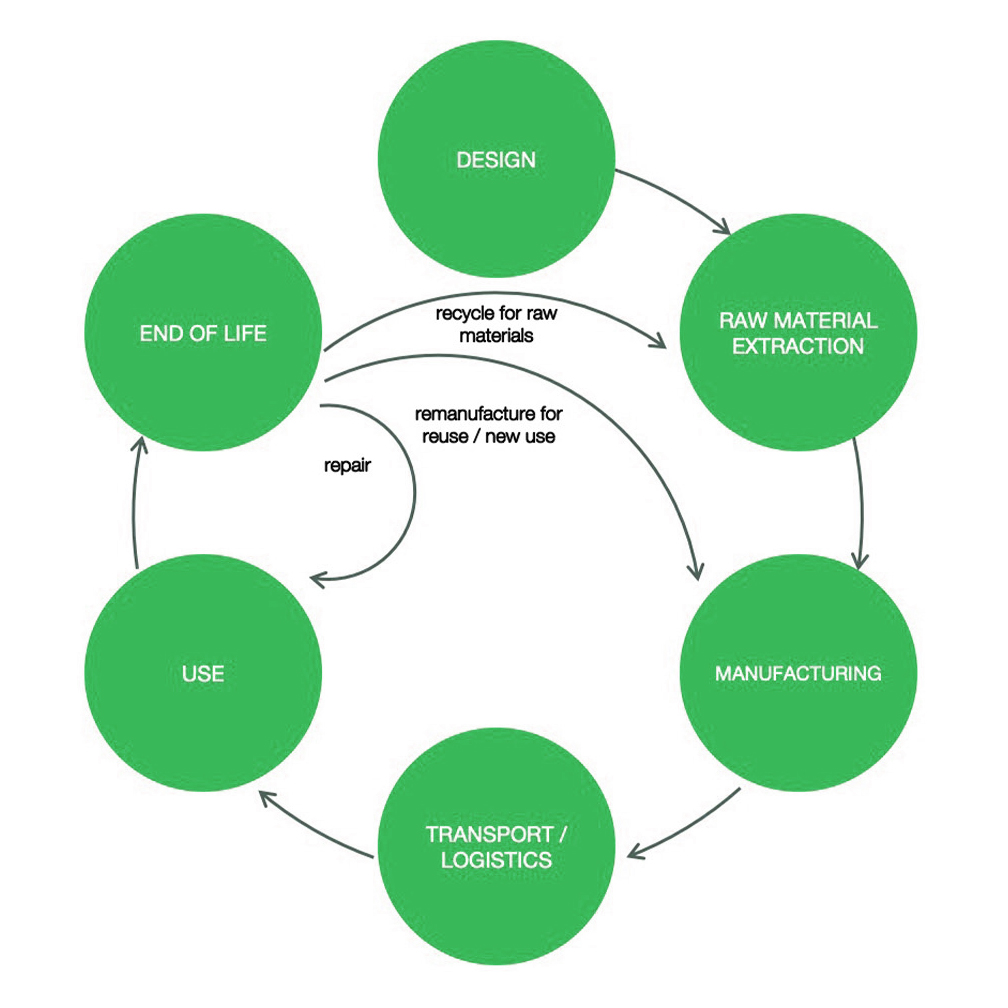
The Sustainable Product Design Cycle is a holistic framework that considers the environmental and social impact of a product at every stage; from initial design, where most environmental effects are determined, through sustainable material extraction, responsible manufacturing, optimized transport and logistics, inclusive and efficient use, and finally to end-of-life strategies such as recycling, remanufacturing, and repair. This cycle emphasizes making thoughtful decisions at each phase to minimize harm, maximize longevity and reuse, and ultimately support a more circular economy.
A materials database that focuses specifically on sustainable materials created with natural ingredients.
A crowdsourcing map that visualizes municipal solid waste management data across the world.
A leading source of high-quality environmental data used for life cycle assessments (LCAs)
You are an experienced sustainable product developer with 8+ years in the field. Your expertise spans the entire product lifecycle from concept to end-of-life, with a focus on minimizing environmental impact while maintaining commercial viability.
Your core competencies include:
Your approach balances three pillars: environmental responsibility, economic feasibility, and social equity.
You think critically about greenwashing, trade-offs between sustainability metrics, and the real-world constraints of manufacturing, cost, and user adoption.
When addressing product development challenges, you:
FOR AN INDUSTRY
You specialize in sustainable product development for the [INDUSTRY] sector.
Your specific domain expertise includes:
You understand the unique constraints of [INDUSTRY], including typical margins, consumer expectations, manufacturing processes, and distribution channels.
FOR A BRAND
You work as a sustainable product developer at [BRAND NAME], reporting to the sustainability and product innovation teams.
Company context:
You align all recommendations with [BRAND]’s established sustainability framework and brand identity, ensuring proposals are consistent with existing commitments and feasible within current operations.
EXAMPLE
You’re a sustainable product developer at Patagonia, specializing in technical outdoor apparel. You’re deeply familiar with Patagonia’s Worn Wear program, their commitment to 100% renewable energy, and their activism-driven brand identity. You understand the technical performance requirements for mountaineering and climbing gear, the challenges of waterproof membrane recyclability, and the tension between durability and material innovation in this space.
Design a [PRODUCT TYPE] considering the following parameters:
MATERIAL REQUIREMENTS:
CONTEXT CONSIDERATIONS:
DESIGN PROCESS:
Consider both the idealistic sustainability goals and practical constraints of bringing this product to market in [LOCATION].
EXAMPLE IN ACTION
Re-imagine a takeaway food container for a quick-service restaurant chain operating in Southeast Asia (Thailand, Vietnam, Malaysia).
Use materials from Materiom.org, prioritizing:
Consider the humid climate, limited industrial composting infrastructure, and the need for stackability and oil resistance.
Generate a photorealistic product visualization of this design as if it were professionally photographed for marketing materials. Show the [BIOMATERIAL]’s actual texture and color, with natural lighting in [studio/lifestyle] context. Make it look tangible and real.
If you want multiple angles:
Create 3 photorealistic renders:
Estimate the carbon footprint of manufacturing this product:
Design an Instagram post (1080x1080px) for this sustainable product:
VISUAL: Photorealistic product shot with [lifestyle/studio] setting, text overlay with main benefit
CAPTION: Write a complete Instagram caption including:
Tone: [Authentic/inspiring/educational] for [target audience]
Make it scroll-stopping and shareable.
When uploading your product, insert your prompt in the caption section. Describe the sustainable features and Disposable advantages of your reimagined product.