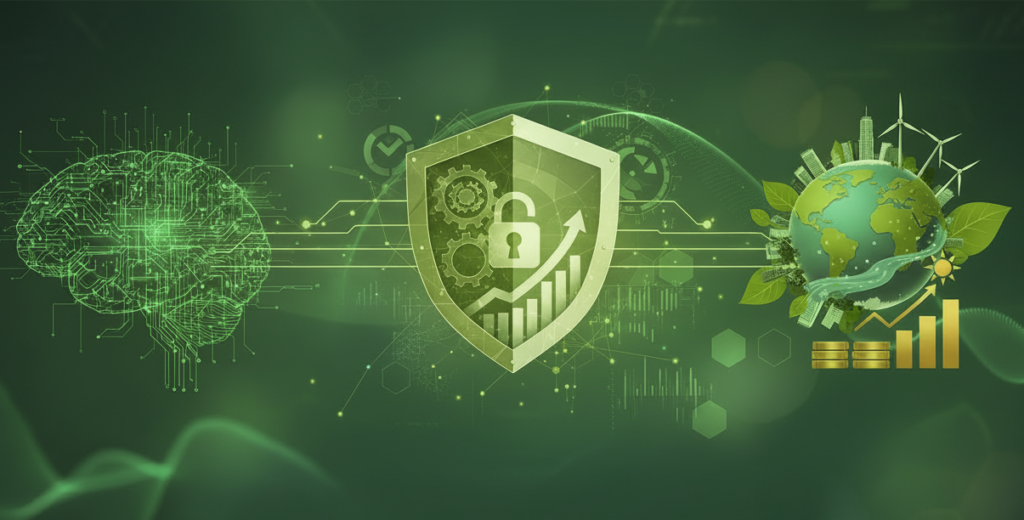
Since the launch of ChatGPT in 2022, Artificial Intelligence (AI) has rapidly become embedded across industries, powering advancements in smart cities, smart healthcare, smart manufacturing, smart virtual environments, and even the Metaverse. A Goldman Sachs report estimates that widespread AI adoption could increase annual global GDP by 7%, equivalent to nearly $7 trillion, over the next decade (Goldman Sachs, 2023). With projections like these, it’s no surprise that organisations across sectors are eager to integrate AI tools into their operations.
However, deploying AI introduces complex challenges around trust, risk, and security. Traditional governance and security controls are not designed to address the unique risks of AI systems, especially for organisations that must safeguard sensitive data and comply with evolving regulatory requirements (Gartner, 2023).
AI TRiSM
To help organisations navigate these challenges, Gartner introduced the concept of AI TRiSM, Artificial Intelligence Trust, Risk and Security Management, in its 2023 report AI Trust and AI Risk: Tackling Trust and Risk in AI Models. In the 2024 Gartner Hype Cycle, AI TRiSM reached the peak of inflated expectations, signalling its emergence as a critical enabling technology.
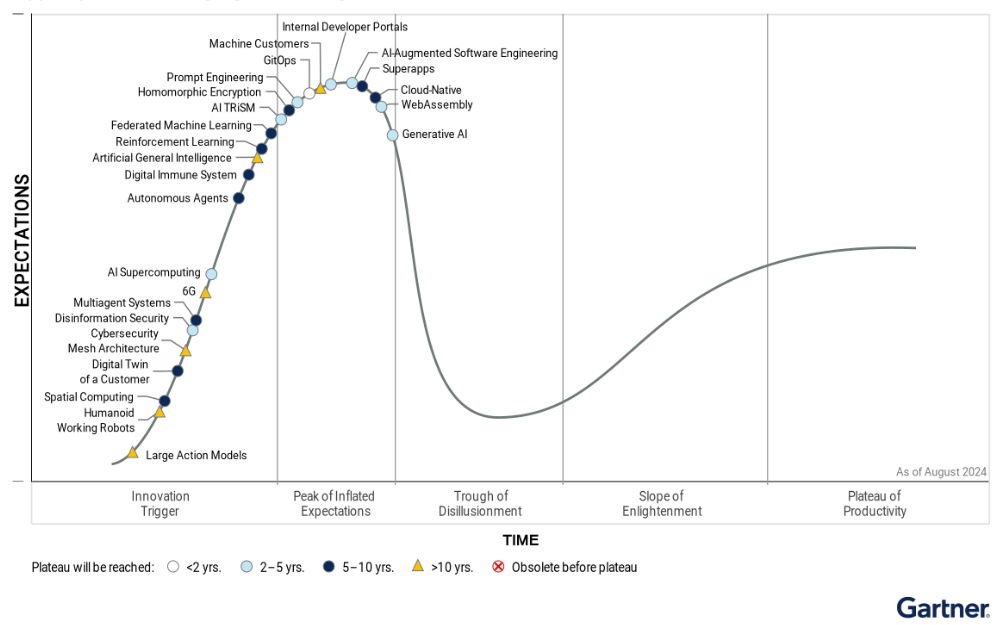
Expected to become a technology fully adopted within the next 5 years, AI TRiSM is no longer a “nice to have”; it has become a foundational requirement for any organisation adopting advanced AI tools such as LLMs, LAMs, agentic AI, or predictive analytics (Gomstyn and Jonker, 2025).
AI TRiSM offers organisations a comprehensive framework that supports a risk‑informed approach to organising people, processes, and technology around data and AI assets. Its purpose is to accelerate innovation while preventing negative outcomes such as regulatory penalties, reputational damage, or the exposure of sensitive information. It addresses risks related to data privacy, security, and ethical considerations (Habbal, 2024).
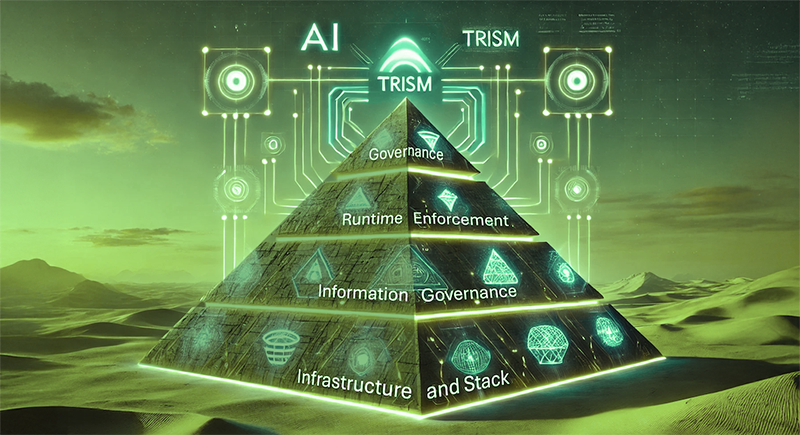
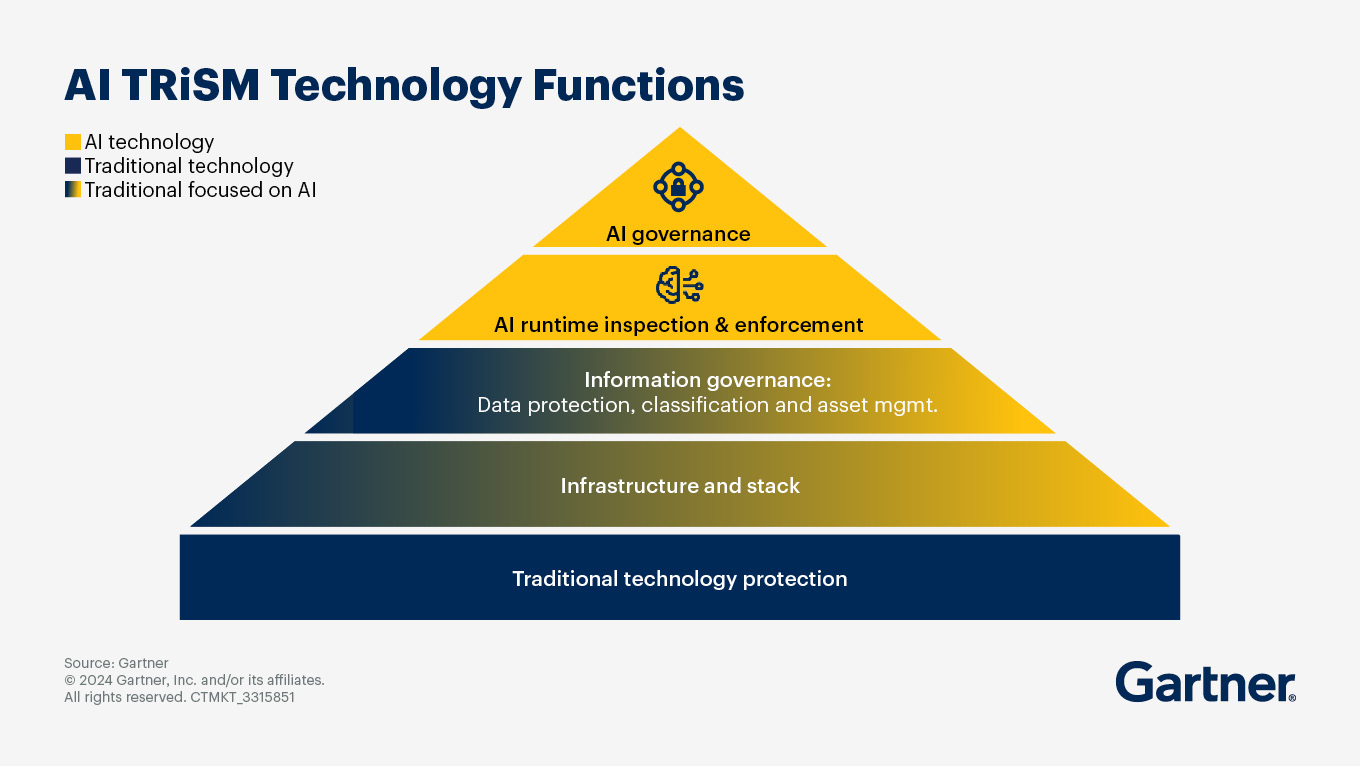
The framework is structured into multiple layers, beginning with secure infrastructure and traditional cybersecurity at the base, but centering its value on three higher layers: Information Governance, AI Runtime Inspection and Enforcement, and AI Governance (Gartner, 2025).
Why is AI TRiSM important?
AI TRiSM brings together essential elements such as transparency, responsibility, fairness, reliability, and ethical considerations. Unlike traditional cybersecurity or privacy frameworks, it addresses AI‑specific risks including bias, model drift, hallucinations, opaque decision‑making, and the misuse of sensitive data. As AI becomes more autonomous and embedded in organisational decision‑making, these risks grow in significance (Habbal, 2024).
Although many standalone frameworks focus on AI trust, AI risk, or AI security, researchers note that they can be difficult to integrate. This fragmentation often leads to inconsistent AI management and gaps in understanding the full risk and security implications of AI adoption. AI TRiSM offers a unified approach by consolidating the most important components of these frameworks into a single, coherent model (Gomstyn and Jonker, 2025).
By adopting AI TRiSM, organisations gain deeper insight into the processes involved in designing, developing, and deploying AI models responsibly (Litan, 2024).
AI TRiSM is important for
- Building Trust: Emphasises transparency, explainability, fairness, and accountability—key factors for public and organisational acceptance of AI.
- Mitigating Risks: Helps identify, assess, and reduce risks such as bias, privacy breaches, discrimination, adversarial attacks, and unintended consequences.
- Enhancing Security: Strengthens protection against data breaches, adversarial manipulation, and malicious use of AI.
- Ensuring Regulatory Compliance: Supports alignment with regulations like GDPR and emerging AI governance standards.
- Promoting Innovation: Reduces uncertainty, enabling organisations to adopt AI confidently and unlock new value.
- Adapting to Emerging Threats: Encourages continuous improvement as new vulnerabilities and AI‑related risks emerge.
- Supporting Ethical AI: Embeds fairness, privacy, and accountability into AI design and deployment.
In Summary
AI TRiSM is becoming essential for building a secure, reliable, and trustworthy AI ecosystem. By addressing the intertwined challenges of trust, risk, and security, it enables organisations to innovate responsibly while protecting their data, reputation, and stakeholders.
For environmental funds like Profonanpe, AI TRiSM is especially relevant. These organisations manage climate‑finance resources, biodiversity data, and sensitive community information. Ensuring that AI systems are transparent, auditable, and ethically aligned is essential for maintaining trust with donors, government partners, and Indigenous communities.
AI TRiSM is not just about preventing harm, it is about enabling responsible innovation. It provides the guardrails that allow organisations to adopt AI confidently, knowing that risks are managed and opportunities can be pursued safely.