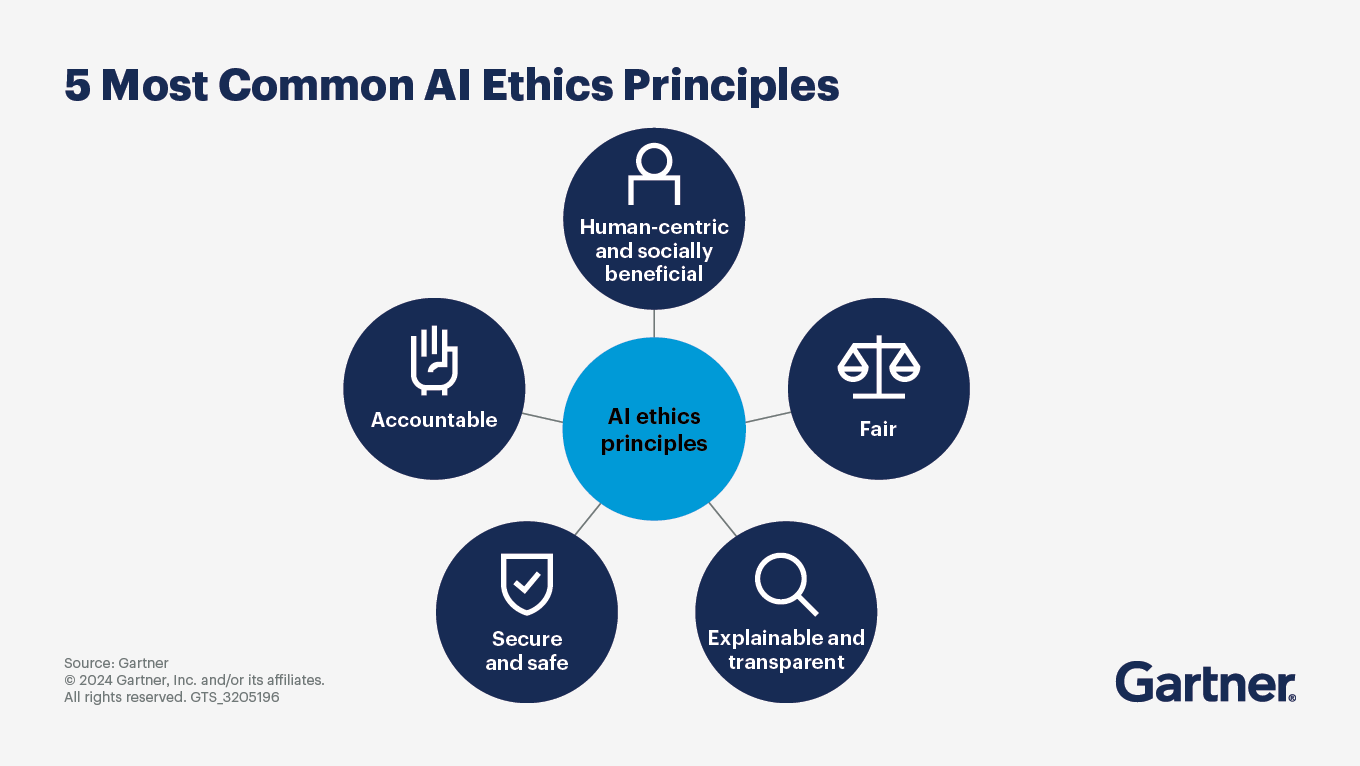
Organisations and environmental finance organisations should ground their TRiSM strategy in the principles of Ethical AI. Ethical AI examines philosophical and societal questions related to fairness, privacy, environmental impact, and workforce disruption (Short, 2025). Gartner identifies five foundational principles that guide responsible AI development:
-
-
- Human‑centric and socially beneficial, protecting well‑being, autonomy, dignity, and societal impact.
- Fairness, ensuring equitable outcomes across protected groups while navigating tensions between transparency and privacy.
- Transparency, enabling understanding of how algorithms are built and trained so hidden biases can be identified and mitigated.
- Accountability, ensuring humans, not machines, remain responsible for AI‑driven decisions and that liability is clearly defined.
- Privacy and security, protecting personal data through strong safeguards, encryption, access controls, and data anonymization.
-
These principles provide the foundation for establishing governance mechanisms that support responsible and ethical AI practices. Governance structures may take the form of a technical board, a cross‑functional council, or a dedicated individual embedded in the AI development process.
Once governance is established, organisations can implement a TRiSM‑focused responsible AI framework that addresses accountability, transparency, and regulatory compliance (Short, 2025).
A roadmap towards AI TRiSM for Profonanpe
Foundation Phase
Start with defining the ethical foundation, then define AI governance principles and assign responsibilities creating a committee. Map and define sensitive data categories and develop risk assessment criteria.
Phase 01: Capacity Building
Build the internal capacity in digital literacy for the organisation. Train on indigenous data ethics and establish internal guidelines for AI use. Create a Digital-first culture encouraging cross team collaboration.
Phase 02: Infrastructure
Build secure trustworthy systems ensuring that the technical environment supports AI adoption. Strengthen cybersecurity protocols and standards. Then adopt model monitoring tools.
Phase 03: Pilot
Test AI tools in controlled low-risk environments. For example, try deployinh AI assisted Theory of Change design using trustworthy AI to accelerate project framing while ensuring cross-checking bias control. Start building non-sensitive data-sets for internal reports, that do not include indigenous or confidential data. Finally evaluate the pilot.
Successful AI TRiSM adoption starts small. Smart organisations focus on one system first, often a simple dashboard, then expand as teams gain confidence. Oversight becomes part of everyday work, supported by clear procedures for handling AI issues. As teams share lessons learned, they build a collective knowledge base that strengthens AI governance across the organization (Sullivan, 2025).
Phase 04: Integration
Scale AI responsibly integrating it into process workflows. Execute continuous monitoring and auditing.
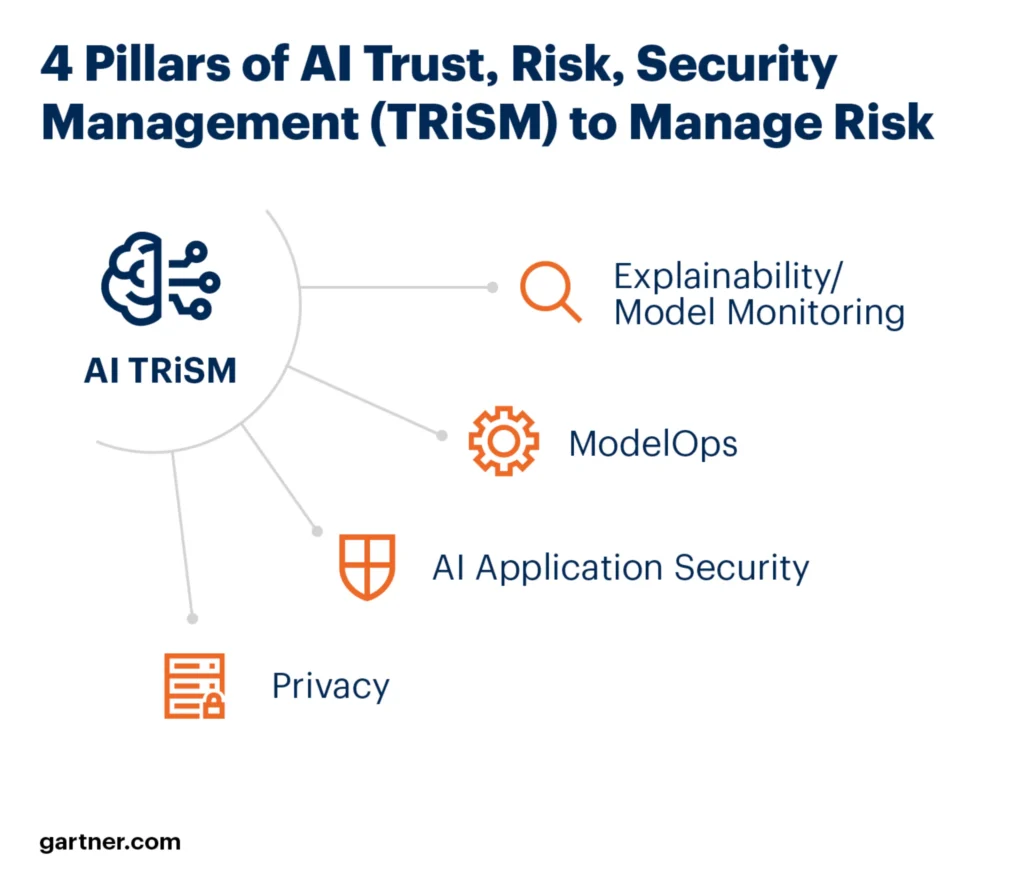
According to Gartner, at this phase, the 4 pillars of AI TRiSM need to be in place to ensure AI systems are trustworthy, resilient, and ethically sound:
- Explainability & Model Monitoring: To ensures AI decisions are transparent and understandable. It clarifies how models work, identifies strengths and weaknesses, checks for bias, and continuously monitors performance.
- Model Operations: Manages AI models throughout their entire lifecycle, ensuring they run efficiently, reliably, and in alignment with ethical and organizational standards.
- AI Application Security: Protects AI systems from cyber threats, safeguarding sensitive data and maintaining system integrity.
- Privacy: Ensures responsible handling of data used in AI, with strong protections for individual privacy, especially critical in sensitive sectors like healthcare.
When implementing AI TRiSM, certain red flags deserve immediate attention. If your AI systems can’t explain their decisions, or if you notice sudden changes in how they behave, that’s worth investigating.
Phase 05: Sustainability
Keep AI governance alive, adaptive and culturally aligned. Execute annual TRiSM audits and regularly update governance policies. Keep constant staff training.
If gaps are found in the documentation about data sources or it is noticed that teams aren’t clear about who’s responsible for AI oversight, these are signs that the AI TRiSM implementation needs a second look.
Available Solutions
By 2025, an estimated 60% of enterprise organisations will adopt responsible AI frameworks, underscoring the growing importance of TRiSM in both financial and environmental sectors. Several platforms already exist to support responsible AI by monitoring robustness, fairness, transparency, accountability, and risk compliance (Sindhu, 2024).